Boże Ciało — a movable feast 60 days after Easter
Boże Ciało (Corpus Christi) is a Catholic feast honoring the Eucharist (Holy Communion): the rite in which bread and wine are consecrated during Mass and, according to Catholic belief, become the Body and Blood of Christ. The feast is always celebrated 60 days after Easter — the second Thursday after Pentecost (Zielone Świątki). The date shifts every year along with Easter: in 2026 it falls on June 4. The holiday is one of Poland's 14 official days off.
Where did Boże Ciało come from, and what is it really about?
The official liturgical name of the feast is Uroczystość Najświętszego Ciała i Krwi Chrystusa (the Solemnity of the Most Holy Body and Blood of Christ). The essence is simple: it's a public profession of faith that Christ is truly present in the consecrated host. That's exactly why the procession moves out into the city streets instead of staying inside the church walls — believers deliberately demonstrate that faith in front of the whole of society.
The feast's origin story begins in the 13th century: a nun named Juliana of Liège had a vision in which Christ asked for a separate feast to be established in honor of the Eucharist. Moved by this, Bishop Robert first introduced such a feast in the diocese of Liège in 1246, but accusations of heresy against Juliana soon caused it to lapse. The cause was taken up by the same diocese's archdeacon, Jacques Pantaléon — who from 1261 became Pope Urban IV. He was finally convinced by a Eucharistic miracle in the Italian town of Bolsena in 1263: during Mass, blood reportedly began dripping from the consecrated host. On August 11, 1264, Pope Urban IV issued the bull "Transiturus", establishing Boże Ciało as a feast for the whole Church.
What happens during the procession
The central element is a street procession: a priest in ceremonial vestments carries a monstrance with the Blessed Sacrament, followed by the parishioners. The procession stops at four altars set up right on the streets and decorated with flowers and birch and linden branches — one for each of the four Gospels (Matthew, Mark, Luke and John). At each altar a passage from the corresponding Gospel is read and hymns are sung. Particularly grand processions traditionally take place in Kraków, Warsaw and Częstochowa.
After the procession, parishioners take birch and linden branches from the altars home and leave them at the doorstep — believed to protect the household. This detail is easy to confuse with the Zielone Świątki custom of decorating homes with greenery beforehand: here the branches are taken after the ceremony, as a kind of protective charm rather than a decoration for the holiday.
Don't stop at the article
The bot has 750 questions in the format of a real consul interview, instant feedback and a mock exam. Try it for free.
Check your level →One day off, four days of rest
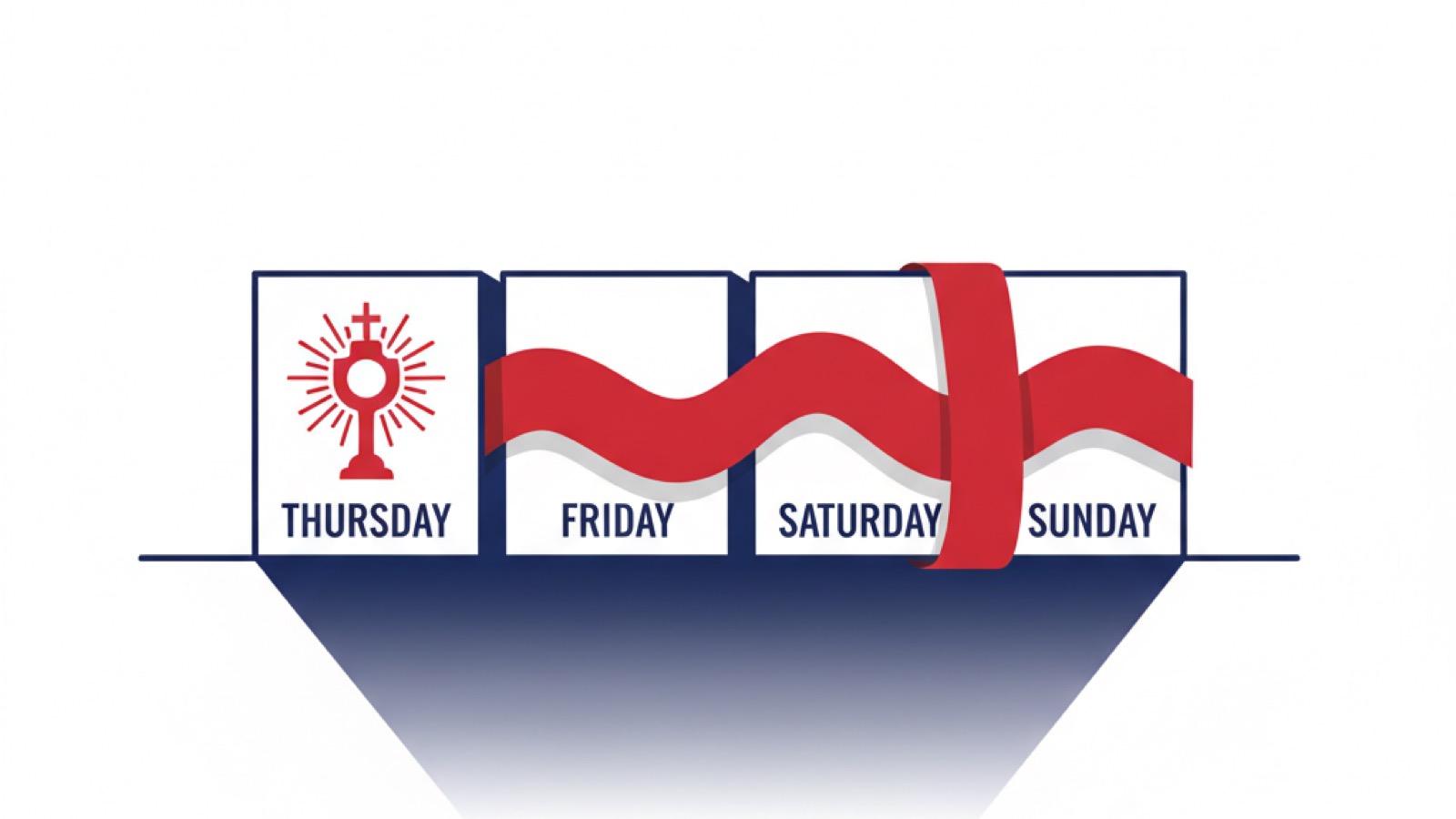
Officially, only Thursday itself is a day off — Friday remains a regular working day. That's precisely why the same practice takes hold around Boże Ciało every year: take one vacation day on Friday and turn the weekend into four days in a row. In Poland this is called a "długi weekend" (long weekend), and travel agencies traditionally see a booking spike during this period, while employers see a spike in leave requests. In 2026, the Friday after the holiday is June 5.
Why the feast "keeps going" — the octave, the Lajkonik, and Łowicz costumes
The feast doesn't end on Thursday. Catholic tradition has an octave — eight days during which churches and believers keep celebrating the solemnity, as if every one of those days were still that same Thursday. The Vatican formally abolished the Corpus Christi octave back in 1955 as part of a liturgical reform, leaving only the octaves of Christmas and Easter. But in Poland, at the request of the bishops, the custom survived — no longer as a liturgical obligation, but as a living folk tradition. It's precisely within this octave, exactly on the eighth day (again a Thursday), that Kraków holds the Lajkonik.
The Lajkonik: a man in a bright Tatar costume riding a decorative hobby horse leads a colorful procession from Zwierzyniec through Wawel to the Main Market Square. According to legend, the tradition commemorates a 13th-century victory of Kraków's residents over the Tatars, and being touched by his mace is said to bring good luck.
In Łowicz (Mazovia), residents wear vivid folk costumes with distinctive colorful stripes for the Boże Ciało procession itself — one of Poland's most famous folk spectacles, drawing tourists from across the country every year.
Another well-known tradition is the flower carpets in the village of Spycimierz (Łódź Voivodeship): residents have spent over 200 years laying kilometer-long patterns of live flowers along the procession's route. In 2021, UNESCO added the tradition to its Representative List of the Intangible Cultural Heritage of Humanity.
Boże Ciało and Zielone Świątki — easy to confuse
Both holidays are movable and tied to the date of Easter, so even long-time residents of Poland mix them up.
49th day after Easter. Always a Sunday. Honors the Descent of the Holy Spirit. Full breakdown in the previous article in the series.
60th day after Easter. Always a Thursday. Honors the Eucharist, with processions to four altars.
The simplest way to keep them straight: Zielone Świątki is always a Sunday and about the Holy Spirit; Boże Ciało is always a Thursday and about processions with the monstrance.
What the consul asks
The typical question is simple: "Kiedy jest Boże Ciało?". The consul checks three things at once: whether you know the exact link to Easter (not just a memorized date), whether you understand the substance of the feast — a procession honoring the Eucharist, and whether you confuse it with Zielone Świątki.
Example of a complete answer: "Boże Ciało obchodzimy sześćdziesiąt dni po Wielkanocy, zawsze w czwartek. To święto ku czci Eucharystii — najważniejszym elementem jest procesja do czterech ołtarzy, podczas której ksiądz niesie monstrancję" — "We celebrate Boże Ciało sixty days after Easter, always on a Thursday. It's a feast honoring the Eucharist — the most important element is a procession to four altars, during which the priest carries the monstrance."
Common mistakes to avoid:
- Confusing Boże Ciało with Zielone Świątki — these are two separate movable feasts with different dates and symbolism.
- Knowing only the date without understanding that the feast honors the Eucharist, not just "another procession".
- Not mentioning the four altars and the monstrance — these details show you've actually observed how a Polish town lives on this day.
- Treating the Friday after Boże Ciało as an official day off — legally it's a regular working day, even though it's popular for taking leave.
The quickest way to check your readiness: explain out loud in 30 seconds, in Polish, the essence of Boże Ciało and how it differs from Zielone Świątki, as if answering the consul right now. In the PLTest bot's "Mock Interview" mode you can rehearse that answer with a timer and instant feedback.
Frequently asked questions
When is Boże Ciało in 2026?
June 4 — 60 days after Easter, always a Thursday.
Can you take one vacation day and get four days off?
Yes. Officially only Thursday is a day off, and Friday is a regular working day. Taking leave on Friday, combined with Saturday and Sunday, gives four days in a row — a popular annual practice in Poland.
What is the Lajkonik?
A Kraków tradition: a procession with a rider in Tatar costume on a decorative hobby horse, held eight days after Boże Ciało (during the octave of the feast); being touched by his mace is said to bring good luck.
How does Boże Ciało differ from Zielone Świątki?
Zielone Świątki is the seventh Sunday after Easter (49th day), always a Sunday, honoring the Descent of the Holy Spirit. Boże Ciało is the 60th day, always a Thursday, honoring the Eucharist, with processions to four altars.
Why are four altars built for Boże Ciało?
To match the four Gospels. At each altar the priest reads a passage from a different Gospel, and the procession visits all four in turn.
Where does the feast of Boże Ciało come from?
The story began with a vision that the nun Juliana of Liège had in the 13th century. The feast was finally established by Pope Urban IV with the bull "Transiturus" on August 11, 1264, prompted by a Eucharistic miracle in Bolsena (1263).