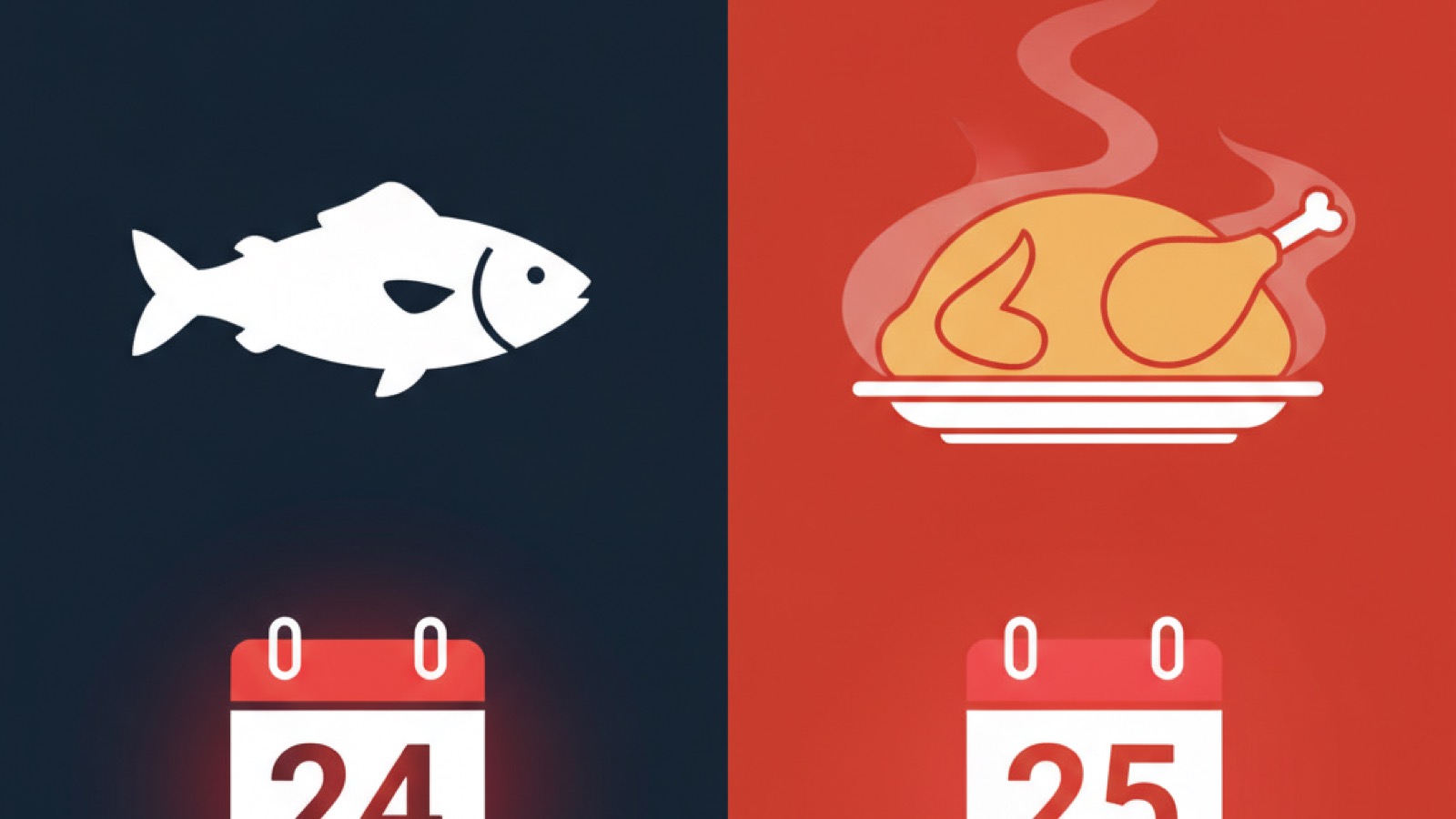
Boże Narodzenie — two holidays, not one
When people talk about Polish Christmas, they usually mean Wigilia — the December 24 supper. But Boże Narodzenie itself officially lasts two days, December 25 and 26, and each is a separate public holiday. In the list of Poland's 14 official holidays, these are two separate items in the law, not one.
The distinction between the two holiday days isn't a formality. It's exactly where the consul often catches inattentive candidates: the first and second day of Christmas in Poland have a completely different character, and confusing them is a typical mistake newcomers make.
December 25 and 26 — two days, two different characters
Formally, both days have the same status — an official day off established by law. But in content and atmosphere, they are two different holidays, each with its own role in the family calendar.
The most solemn day. It starts at night with Pasterka — the mass attended right after the December 24 supper. During the day, the family gathers for a festive dinner (obiad świąteczny) where, unlike the meatless Wigilia supper, meat dishes are now served — turkey, duck, or bigos. The day is spent exclusively with the closest family.
The second official day off, named after St. Stephen, the first Christian martyr. The tone is different — calmer and more social: Poles visit friends and extended family they didn't see the day before. A typical mistake is calling it just 'the second day' without knowing the saint's name.
During the interview, people often assume only one day — December 25 — is officially off. In fact, December 26 has the same state status, just a different, less solemn character.
Don't stop at the article
The bot has 750 questions in the format of a real consul interview, instant feedback, and a mock exam. Try it for free.
Check your level →Pasterka: why the midnight mass is called that
Pasterka is the solemn midnight mass the whole family attends right after the December 24 supper, before or around midnight. The name comes from 'pasterze' — shepherds who, according to the Gospel account, were the first to greet the newborn Christ. After the mass, families often sing carols together (kolędowanie) — a detail that shows the consul you know not just the date of the holiday but its living atmosphere.
Language nuance: the word 'Pasterka' is feminine and used with the preposition 'na' — 'byliśmy na Pasterce', 'idziemy na Pasterkę'.
Who brings the gifts — and why you shouldn't say 'Dziadek Mróz'
The classic answer is Święty Mikołaj. But different regions of Poland have their own characters: in Poznań, children's gifts are brought by Gwiazdor, in Kraków by Aniołek, and in Silesia by Dzieciątko. Knowing these variants signals to the consul a deeper familiarity with the country, not a memorized template.
Catholic Christmas on December 25 is no longer a 'foreign' holiday for Ukrainians
Until recently, a question about the December 25 date sounded odd to many Ukrainians: under the old calendar, Christmas was celebrated on January 7. But on July 28, 2023, President Zelenskyy signed a law officially moving Ukraine's state Christmas observance to December 25, and the Orthodox Church of Ukraine switched to the Revised Julian calendar starting September 1, 2023. Since then, for most Ukrainians, December 25 is already their own date, not just a 'Polish' one.
This is an important nuance for the interview: a typical mistake from the consul's question bank is confusing Polish Catholic Christmas with the Orthodox one on the old calendar (a 13-day difference). Mentioning that the date in Ukraine and Poland has aligned since 2023 shows genuine understanding rather than a memorized answer.
What the consul asks
The questions are simple: "Kiedy katolicy obchodzą Boże Narodzenie?", "Jak nazywa się drugi dzień Bożego Narodzenia?", "Proszę nazwać dwa najważniejsze święta w Polsce". Each one checks not just the date, but a detail only someone who truly understands the topic would know.
Example of a full answer: "Boże Narodzenie obchodzimy 25 i 26 grudnia — oba dni są ustawowo wolne od pracy. Pierwszy dzień, 25 grudnia, spędzamy w gronie najbliższej rodziny, po nocnej Pasterce. Drugi dzień, 26 grudnia, to Dzień Świętego Szczepana — wtedy odwiedzamy znajomych i dalszą rodzinę" — "We celebrate Christmas on December 25 and 26 — both days are statutory days off. The first day, December 25, we spend with our closest family, after the midnight Pasterka. The second day, December 26, is St. Stephen's Day — when we visit friends and extended family."
Typical mistakes to avoid:
- Assuming only December 25 is an official day off, forgetting the 26th.
- Calling the second holiday day just 'the second day' without knowing St. Stephen's name.
- Saying 'Dziadek Mróz' instead of 'Święty Mikołaj'.
- Confusing Polish Catholic Christmas with the Ukrainian Christmas before 2023 (January 7), without knowing about the calendar change.
- Calling the midnight mass just a 'service' instead of 'Pasterka'.
The quickest way to check your readiness is to explain out loud, in Polish, in 30 seconds, the difference between December 25 and 26, as if answering the consul right now. The 'Mock Interview' mode in the PLTest bot lets you practice this answer with a timer and instant feedback.
Frequently asked questions
When do Catholics in Poland celebrate Christmas?
December 25, right after the festive Wigilia supper on the evening of December 24.
Is December 26 an official day off in Poland?
Yes. It's Drugi Dzień Świąt, or St. Stephen's Day — the second consecutive public holiday after December 25.
Who brings gifts to children in Poland?
Usually Święty Mikołaj, though in some regions it's Gwiazdor in Poznań, Aniołek in Kraków, or Dzieciątko in Silesia.
How does Catholic Christmas differ from the Ukrainian one?
Since December 25, 2023, the dates match: that's when Ukraine officially moved its state Christmas observance from January 7 to December 25.
What is Pasterka?
The solemn midnight mass on the night of December 24-25, named after the shepherds who, according to the Gospel account, were the first to greet the newborn Christ.