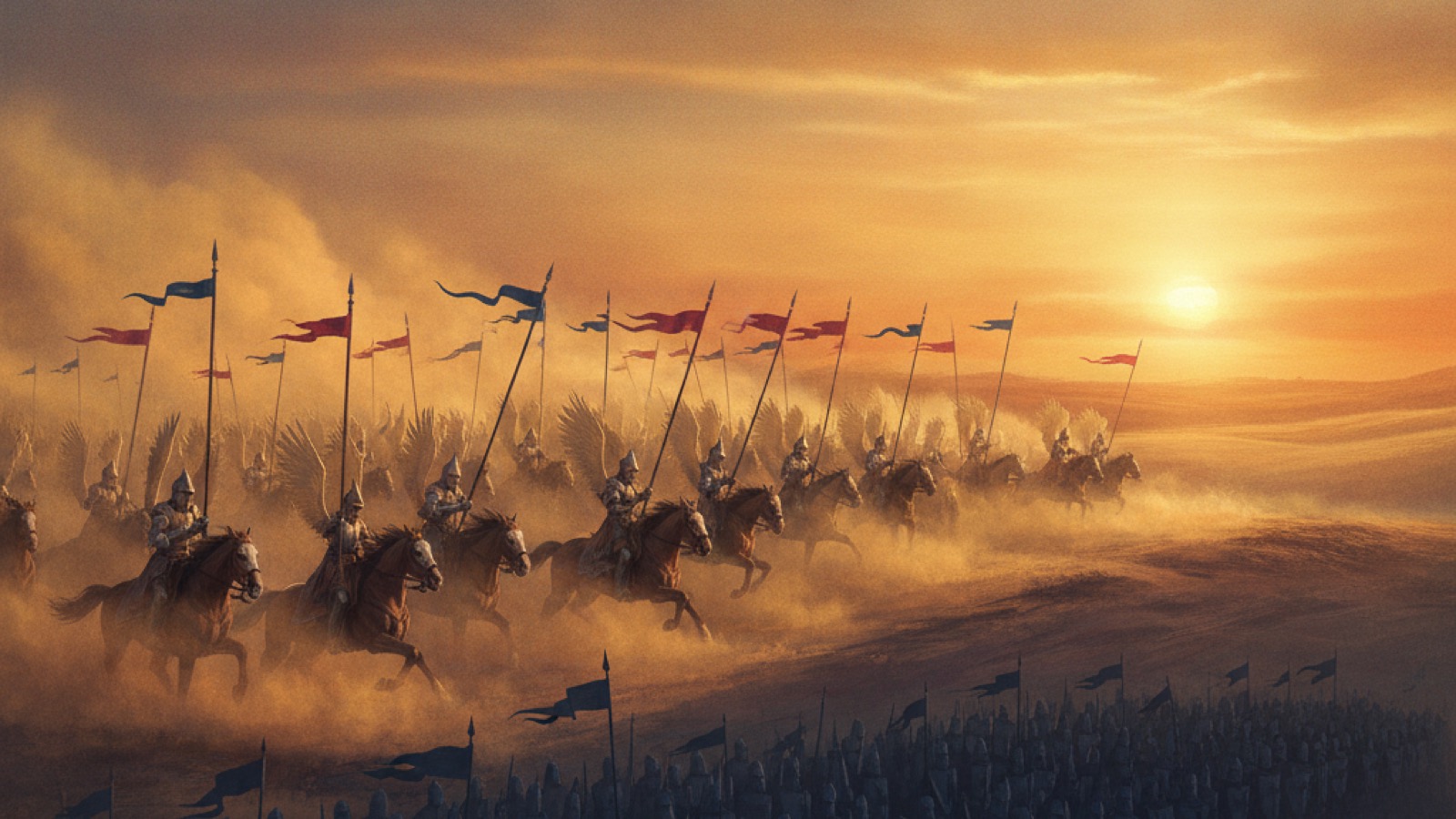
July 15 isn't an official holiday, but it's a date that matters
On July 15, 1410, near Grunwald, the combined Polish-Lithuanian army crushed the Teutonic Order — one of medieval Europe's largest battles. It's not one of Poland's 14 official public holidays (see our full calendar in a separate article), but it remains one of the most significant dates in the country's history and comes up regularly in conversations about Polish identity.
How the Teutonic Order ended up in Poland
In 1226, Duke Konrad of Masovia invited the Teutonic Order to defend against raids by pagan Prussians. The crusader knights handled the job — and stayed, gradually turning from an ally into the biggest military threat to Poland and Lithuania for two centuries.
The Union of Krewo: a common enemy unites Poland and Lithuania
In 1385, Polish Queen Jadwiga (who reigned from 1384 to 1399) signed the Union of Krewo with Grand Duke Jogaila of Lithuania: marriage, Lithuania's conversion to Christianity, and, most importantly, a military alliance against the Teutonic Order. It was this union that made the joint army at Grunwald possible a quarter-century later.
The immediate trigger: the Samogitian uprising
The formal trigger for the war was the 1409 uprising in Samogitia against Teutonic rule, backed by Grand Duke Vytautas. Poland openly declared its support for Lithuania and threatened to invade Prussia. In response, Grand Master Ulrich von Jungingen declared war on both the Kingdom of Poland and the Grand Duchy of Lithuania on August 6, 1409. The deeper cause of the conflict was that the Order kept looking for reasons to keep conquering Lithuanian lands even after Lithuania converted to Christianity, which had removed the formal justification of a "crusade against pagans."
Don't stop at the article
The bot has 750 questions in the format of a real consul interview, instant feedback, and a mock exam. Try it for free.
Check your level →The battle itself: July 15, 1410
The combined Polish-Lithuanian army, led by King Władysław Jagiełło and Grand Duke Vytautas, met the army of the Teutonic Order, led by Grand Master Ulrich von Jungingen, near the villages of Grunwald and Tannenberg. The fighting lasted about eight hours. Grand Master Ulrich von Jungingen was killed in battle — King Jagiełło himself didn't personally join the fighting, directing the battle from a distance. The Polish-Lithuanian victory permanently broke the Order's military power.
Why the Teutonic Knights lost
The battle took place on a hot summer day, and the heavy armor of the Teutonic knights, once considered an advantage, exhausted the soldiers under the blazing sun. The key turning point was the death of Grand Master Ulrich von Jungingen in battle — after that, the Teutonic army lost its unified command. Historians still debate the episode of the Lithuanian cavalry's retreat early in the battle: some researchers consider it a deliberate tactical maneuver, luring the enemy in for a sudden counterattack, while others see it as a genuine flight under pressure that happened to work in the allies' favor. The consequences for the Order were catastrophic: historians estimate the total size of the Teutonic army at anywhere from 11,000 to 27,000 soldiers — the exact figure is still debated, with Polish researchers traditionally citing higher numbers and German ones lower — and according to Teutonic payroll records, only about 1,400 soldiers returned from the battlefield to collect their pay. Even more telling: of roughly 270 knight-brothers of the Order itself, between 203 and 211 died in the battle.
What came next
The Union of Horodło in 1413 cemented the alliance: Lithuanian Catholic boyars received the rights of Polish nobility. But it took another 56 years to fully tame the Order — under the Second Peace of Toruń in 1466, Poland regained Pomerelia and Warmia, and the Teutonic Order itself became a vassal of the Polish king.
The battle's cultural legacy
Before the battle, the knights sang "Bogurodzica" — the oldest Polish patriotic and religious song, which served as a battle hymn until the 16th century. More than 450 years later, in 1878, painter Jan Matejko created the monumental canvas "The Battle of Grunwald" — one of the best-known works of Polish painting, one that still shapes how Poles picture the victory today. Malbork Castle itself — once the Grand Master's seat — has survived to this day and has been a UNESCO World Heritage Site since 1997 as the largest Gothic fortress in the world.
What the consul asks
Questions about the Battle of Grunwald come up regularly among PLTest's verified questions: when the battle took place and who won, who painted the famous picture of it, who Jan Matejko was. It's part of a broader block of historical questions about the Jagiellonian dynasty — from Jadwiga and Jagiełło's marriage to the union with Lithuania.
July 15, 1410. The combined army of King Władysław Jagiełło crushed the Teutonic Order — its power was permanently broken.
Jan Matejko, in 1878 — one of the most famous Polish historical painters.
Poland's most famous historical painter (1838-1893), known for monumental canvases depicting key moments in Polish history.
Common mistakes
July 15 isn't one of Poland's 14 official public holidays — it's a regular working day.
The Polish-Lithuanian army won, not the Teutonic Order itself — this mix-up happens even to people who generally know the battle exists.
This isn't a purely Polish victory but a joint one with the Grand Duchy of Lithuania — an alliance sealed by the 1385 Union of Krewo.
"Who painted the Battle of Grunwald" is a real question from the PLTest database. The correct answer is Jan Matejko, 1878.
Frequently asked questions
Is July 15 an official public holiday in Poland?
No. It's not one of the 14 official public holidays set by law. It's an important historical date, not a state holiday.
Who won the Battle of Grunwald?
The combined army of the Kingdom of Poland and the Grand Duchy of Lithuania, led by King Władysław Jagiełło and Grand Duke Vytautas.
How long did the battle last?
About eight hours of fierce fighting.
Why was the Teutonic Order in Poland in the first place?
Duke Konrad of Masovia invited them in 1226 to defend against the Prussians — the Order later turned into a threat.
What does Jan Matejko's painting depict?
The battle's climactic moment — a monumental 1878 canvas, one of the best-known works of Polish historical painting.